
OPTIHEAT PROJECT
OPTIHEAT is an advanced hardware and software solution for controlling, monitoring and optimizing heat pumps.
- Heating cost savings up to 15% for heat pump owners
- Advanced smart grid control with energy consumption forecasting
- Maximum comfort with maximum savings
Smart algorithms
The heat pump optimization is based on weather forecast, energy prices and house-specific thermal characteristics.
An example of optimized operation of air-water HP and 2-tariff electrical price is shown on Figure 1 below. The bottom graph shows the outdoor temperature within a 24 hours calculation interval. The top graph shows the simulated indoor temperature (red line), heating price (cyan line), pump operation (yellow bars), and maximum room offset (gray horizontal bar).
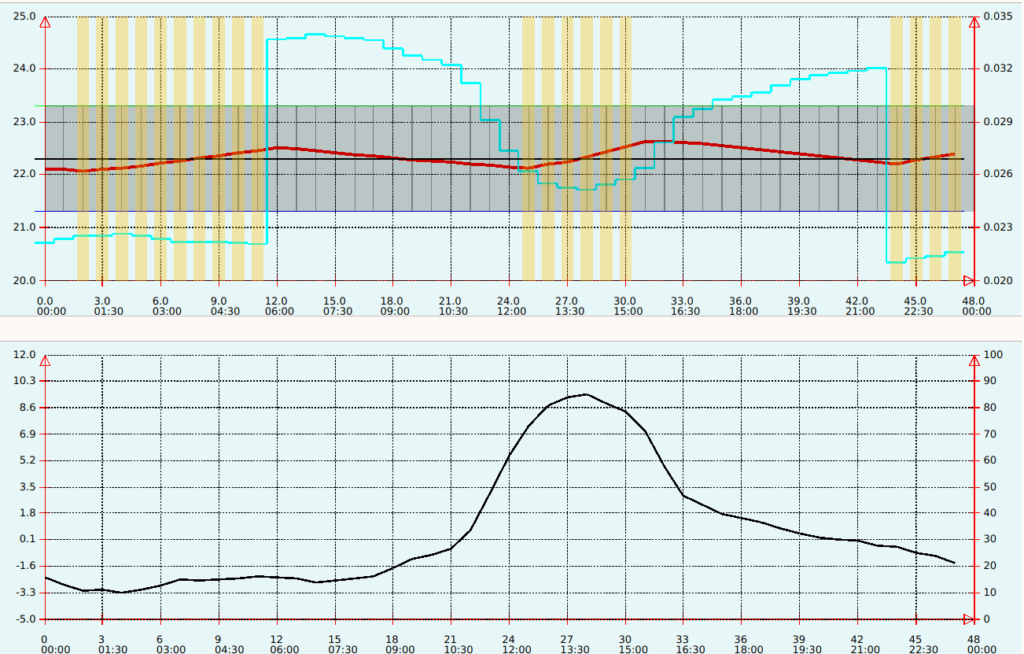
The working intervals shift towards lower heating costs. In this example the lowest price is at night (low tariff) and in the middle of the day when the outdoor temperature and COP is highest.
This kind of operation can be performed most of the time during the heating season. The exception is very low temperatures throughout the day when the HP must operate without interruption to heat the building.
Arranging the operating intervals
The higher the source temperature the better the efficiency of the heat pump. If we can accumulate the heat, we can turn that into advantage, especially with air-to-water systems where the outside temperature changes throughout the day. With floor heating, there is no need for additional heat storage because the mass of the floor is a great store of heat. Even if we switch off the heating for a few hours, this will not be noticed and will not affect the thermal comfort. In the case of radiator heating, fan coils or ventilation, additional heat storage is required as they do not provide accumulation capacity.
To achieve proper heat storage with underfloor heating, we allow a small deviation of the room temperature from the desired temperature. In order not to compromise thermal comfort, the temperature offset is limited (gray horizontal bar).
The algorithm shifts the operation more to the cost-effective intervals and tries not to operate at a higher cost. The cyan line represents the heating cost calculated based on the outdoor temperature and the electricity price. In this example, the heat pump works mainly at night where electricity price is lower (Slovenian 2-tariff system 10 pm to 6 am). There is also a narrow interval in the middle of the day when the outdoor temperature and COP are highest. This is a typical daily operation for air-water HP with underfloor heating and 2-tariff electricity price.
Finding the ideal heating curve
Finding the ideal heating curve setting is all too often forgotten. When the heat pump is installed, the circuits water flow settings (heating curve) is set by the installer who cannot know exact thermal characteristics of the building. The water flow temperature is often set to a higher value than necessary, which results in a lower COP and often in higher heat losses due to overheating of the room.
The only way to find the best settings is to spend a lot of time experimenting with adjustments during the heating season. Heat pump owners usually do not even know about that or they simply do not care.
Optiheat offers very advanced heating curve optimization that takes into account interval shift capability. Higher temperature boost provide more shift as heat can be generated in a shorter time, but s COP decreases. In general, the higher the price difference between intervals the higher the optimal boost.
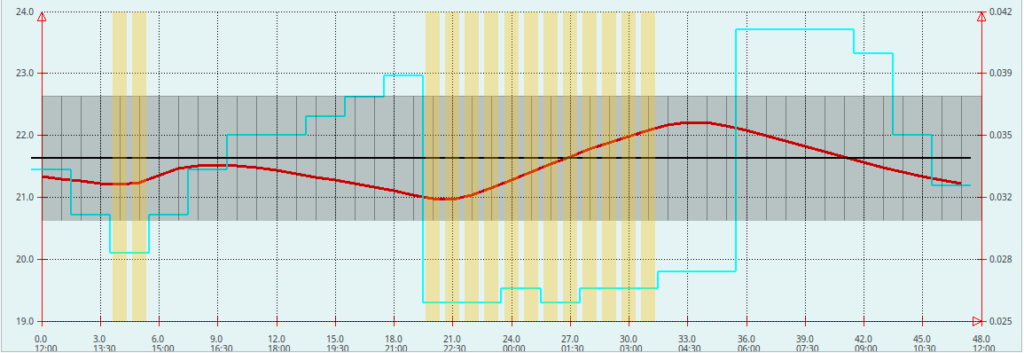
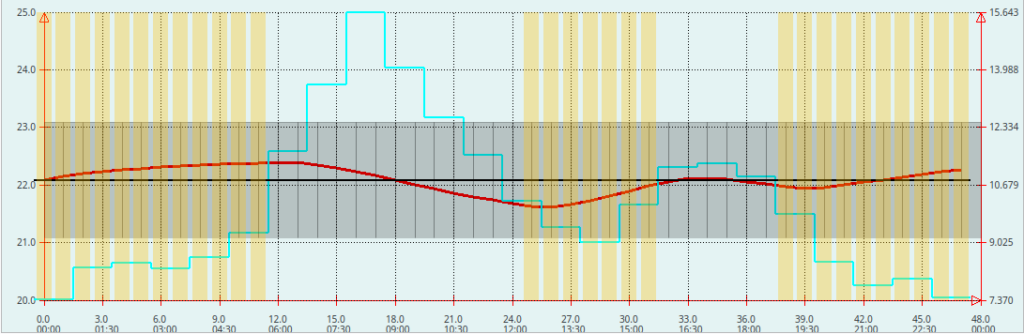
The following example below shows the optimized operation for 3 different boosts for a calculation period of 24 hours.
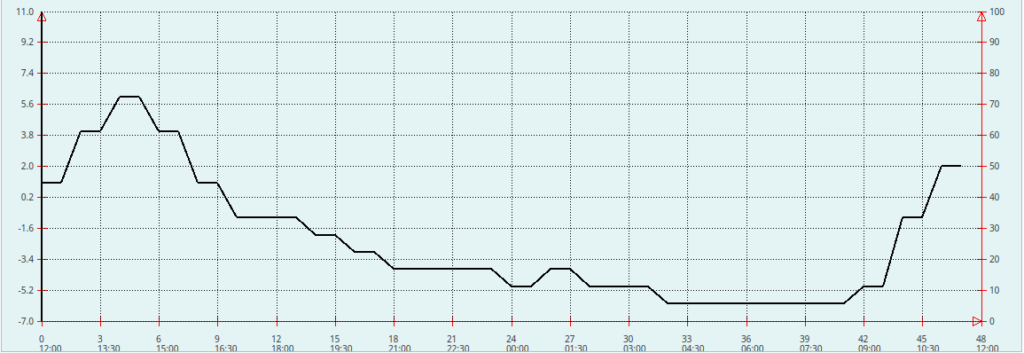
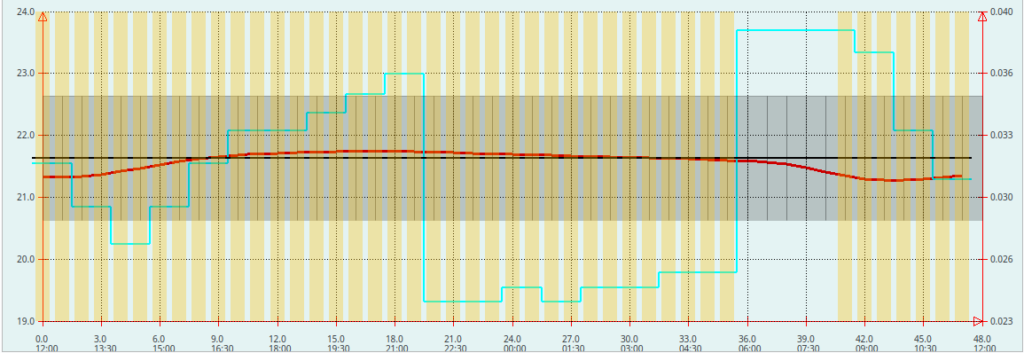
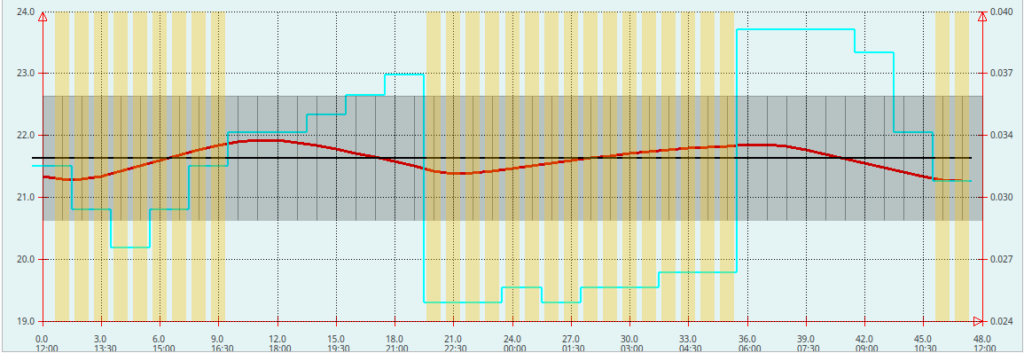
When the boost is too low, as shown on Figure 3, the heating system must operate for most of the day to maintain the desired indoor temperature, so shifting the intervals is not possible. Although the COP is best due to the lowest heating curve, the most expensive intervals cannot be avoided (around 9 pm and 5 am).
Too high boost narrows the working intervals, but COP is lower (Figure 4). In addition, too aggressive room overheating may affect thermal comfort.
The optimal boost is somewhere in between. As can be seen in Figure 5, the intervals are wider compared to the high boost example, but it is possible to avoid the most expensive intervals.
Self-learning algorithms
The thermal characteristics of a building are not easy to determine. Each house is a unique system with its own physical characteristics (insulation, heat accumulation, sun radiation gains, wind, etc.) and specific HVAC systems (radiators, floor heating, ventilation, etc.). In addition, internal heat gains are highly dependent on lifestyle habits and activities, which vary from one building to another.
Smart algorithm analyzes the previous operation and creates virtual physical model. Self-tuning has an evolutionary approach as it improves over time – the more statistics available, the better the optimization. A well tuned virtual model is able to make more accurate predictions and provides better cost savings and energy consumption savings.
Cost savings
There is no easy way to measure how much a system with intelligent algorithms can save in costs.
Based on air-to-water heat pump simulations, it is possible to save up to 15% of heating costs for a 2-tariff system (about 30% price difference) and about 10% for a single tariff system, taking into account that the heat pump and its settings are optimally selected in non-optimized mode.
In the real world, however, the savings could be even greater if the heat pump settings are not optimally chosen. A typical example is a heating curve that is not set correctly.
Applications
All types of heating systems with heat pumps can be efficiently controlled by Optiheat.
Domestic hot water heating
Water heating represents quite a large proportion of total energy consumption.
The algorithms are able to predict hot water consumption in addition to heating, which improves the prediction of HP operation.
Thermal comfort
To accumulate heat without additional storage, we need to allow the system to slightly increase or decrease the room temperature. The Optiheat system operates within an adjustable room temperature operating range with upper and lower limit (a small deviation from the desired temperature up to +-1°C).
In on our experience, a small deviation from the desired room temperature of up to ±1°C practically does not affect thermal comfort.
Smart grid
Optiheat has great potential for smart grid control. Using the electricity price intervals of intraday trading as input for smart algorithms, heat pump clusters can be controlled very efficiently to optimize grid load.
Compared to the existing SG-ready systems, Optiheat provides monitoring and prediction for each heat pump with real-time updated comfort level, which is essential to avoid compromising the user’s thermal comfort.
Optiheat controller
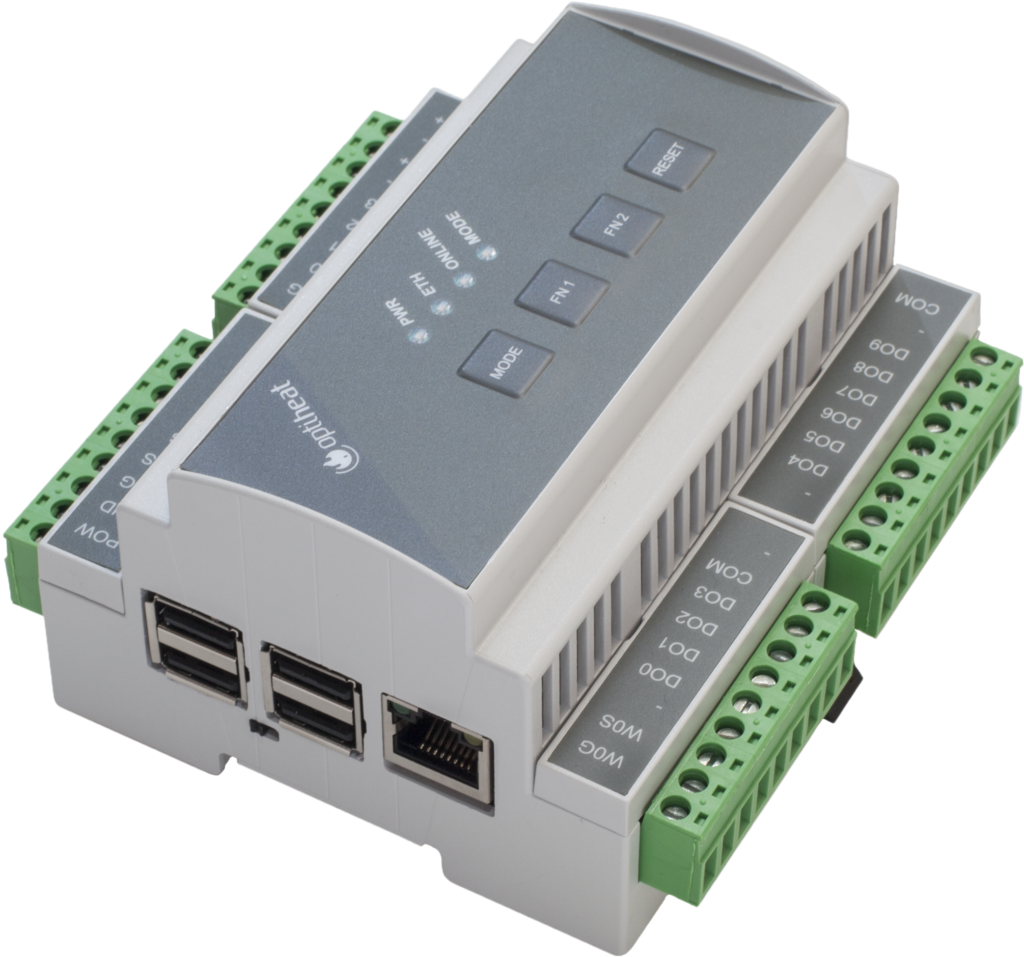
- 10 relay outputs (relays switching voltage: max 277 VAC, max 5A each pin)
- 4 analog inputs (PT100, PT1000 temperature sensors)
- 4 analog outputs 0…10 V
- 2 digital inputs 24VDC
- 2 one-wire ports (each up to 6 one-wire temperature sensors)
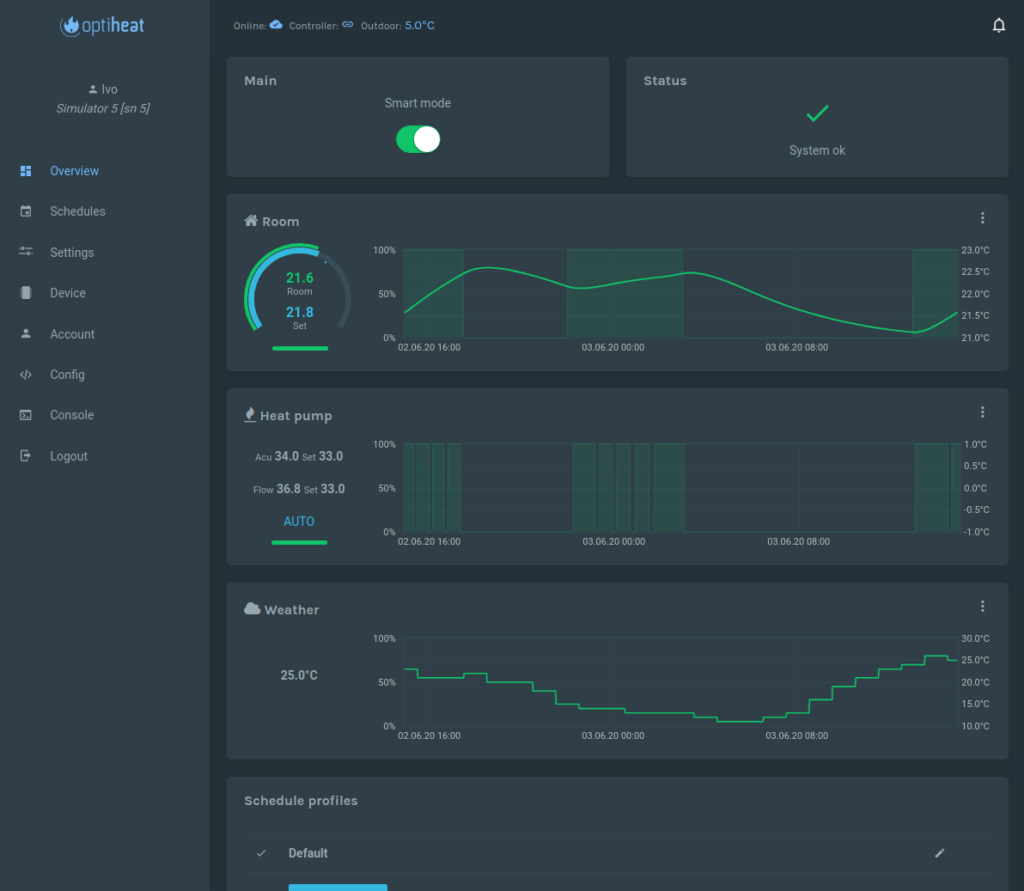
Control panel
Projects
- Heat pumps installations Mitsubishi Electric, Kronoterm, Toshiba, Termo+ HeatPumps
- Elektrina Cloud Solution (Kronoterm heat pumps) smart algorithms integration
- Gen-i heat pump grid control platform